
Three-Way Plug Valves
What are Three-Way Plug Valves?
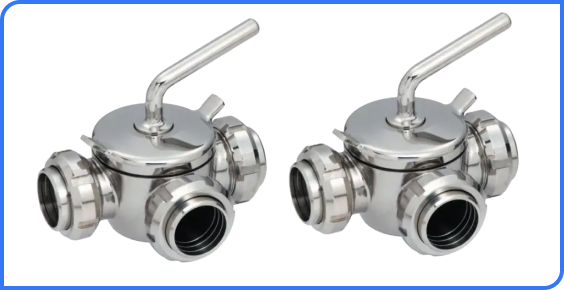
Three-Way Plug Valves are multi-port valves used to divert or mix fluid flow in sanitary systems. Designed for dairies and food processing units, they enable switching between multiple pipelines or directing flow with minimal downtime. These valves are known for their precise routing, clean internal structure, and hygienic sealing.
Asiad Steel Industries manufactures and exports a wide range of Three-Way Plug Valves with options for manual or pneumatic operation to suit dairy-grade applications.
Key Features

Leak-Proof
Jointing

Sanitary
Design

Easy to
Clean

Standards
Compliant

Corrosion
Resistant
Specifications
| Specification Category | Parameter / Feature | Details / Options |
|---|---|---|
| Size Range | Nominal Size | ½” to 4″ (custom sizes available) |
| Pressure Ratings | ANSI / ASME Class | Class 150, 300, 600 |
| PN Ratings | PN10, PN16, PN25, PN40 | |
| Valve Type | Product Type | Three-Way Plug Valve, Hygienic / Sanitary Design |
| Material Options | Body & Plug | Stainless Steel SS304, SS316, SS316L |
| Seals / Gaskets | EPDM, PTFE, Silicone (Food Grade) | |
| Standards & Certifications | ASTM | ASTM A351, ASTM A182 |
| ASME / ANSI | ASME B16.34, ASME BPE | |
| European Standards | EN 1092, ISO 2852 | |
| Certifications | 3A Sanitary, FDA, ISO 9001, CE Marked | |
| Design Features | End Connections | Socket Weld, Butt Weld, Tri-Clamp, Flanged |
| Flow Type | Three-Way, L-Port or T-Port Configuration | |
| Operating Temperature | -20°C to 180°C (depending on seal material) | |
| Surface Finish | Ra ≤ 0.8 µm (internal), Polished / Pickled External | |
| Tolerance | Dimensional Tolerance | As per ASME BPE / EN Standards |
| Coating & Surface Finish | Anti-Corrosion | Passivation, Electro-Polished |
| Optional Coatings | PTFE Coating, Nickel Plating | |
| Testing & Inspection | Pressure Testing | Hydrostatic, Pneumatic |
| Non-Destructive Testing | Dye Penetrant (DPT), Magnetic Particle (MPI) | |
| Destructive Testing | Torque Test, Seal Integrity Test | |
| Operating Features | Operation | Manual Lever, Pneumatic or Electric Actuation Optional |
| Leakage Rate | Bubble Tight / Zero Leakage as per API 598 |
Dimensions
| Nominal Size (DN / NPS) | Face-to-Face (L) | End-to-End (H) | Bore Diameter (D) | Weight per Piece |
|---|---|---|---|---|
| ½” (15 mm) | 100 mm | 140 mm | 15 mm | 1.5 kg |
| ¾” (20 mm) | 110 mm | 155 mm | 20 mm | 1.9 kg |
| 1″ (25 mm) | 125 mm | 170 mm | 25 mm | 2.5 kg |
| 1½” (40 mm) | 150 mm | 200 mm | 40 mm | 4.0 kg |
| 2″ (50 mm) | 180 mm | 230 mm | 50 mm | 5.5 kg |
| 3″ (80 mm) | 230 mm | 280 mm | 80 mm | 9.0 kg |
| 4″ (100 mm) | 280 mm | 340 mm | 100 mm | 13 kg |
Mechanical Properties
| Property | Value | Unit / Standard |
|---|---|---|
| Tensile Strength | 485 – 750 | MPa (SS304 / SS316 / SS316L) |
| Yield Strength | 170 – 450 | MPa |
| Hardness | 120 – 200 | HB (Brinell) |
| Elongation | ≥ 20 – 30 | % |
| Density | 7.9 – 8.0 | g/cm³ |
| Impact Toughness | ≥ 27 – 70 | J (Charpy, grade-dependent) |
| Modulus of Elasticity (E) | ~200 | GPa |
| Fatigue Strength | 250 – 450 | MPa |
| Corrosion Resistance | Excellent (SS316L > SS316 > SS304) | – |
| Thermal Conductivity | 15 – 25 | W/m·K |
| Coefficient of Thermal Expansion | 16 – 18 ×10⁻⁶ | /°C |
| Yield Ratio (YS/UTS) | 0.40 – 0.65 | – |
| Poisson’s Ratio | 0.27 – 0.30 | – |
| Brinell Hardness Range | 120 – 200 | HB |
| Surface Finish | Ra ≤ 0.8 µm (internal), Polished / Pickled external | – |
| End Connections | Butt Weld, Socket Weld, Tri-Clamp, Flanged | – |
| Operating Temperature Range | -20 to 180 | °C (depending on seal material) |
| Pressure Rating | Class 150, 300, 600 / PN10 – PN40 | ASME B16.34 / EN Standards |
| Leakage Rate | Bubble tight | API 598 |
Chemical Composition
| Element | SS 304 | SS 304L | SS 316 | SS 316L |
|---|---|---|---|---|
| Chromium (Cr) | 18.0 – 20.0 | 18.0 – 20.0 | 16.0 – 18.0 | 16.0 – 18.0 |
| Nickel (Ni) | 8.0 – 10.5 | 8.0 – 12.0 | 10.0 – 14.0 | 10.0 – 14.0 |
| Carbon (C) | ≤ 0.08 | ≤ 0.03 | ≤ 0.08 | ≤ 0.03 |
| Manganese (Mn) | ≤ 2.00 | ≤ 2.00 | ≤ 2.00 | ≤ 2.00 |
| Silicon (Si) | ≤ 1.00 | ≤ 1.00 | ≤ 1.00 | ≤ 1.00 |
| Phosphorus (P) | ≤ 0.045 | ≤ 0.045 | ≤ 0.045 | ≤ 0.045 |
| Sulfur (S) | ≤ 0.030 | ≤ 0.030 | ≤ 0.030 | ≤ 0.030 |
| Iron (Fe) | Balance | Balance | Balance | Balance |
| Molybdenum (Mo) | — | — | 2.0 – 3.0 | 2.0 – 3.0 |
Applications of Three-Way Plug Valves
Construction &
Infrastructure
Automotive & Heavy
Equipment
Manufacturing &
Fabrication
Medical & Laboratory
Equipment
Electrical &
Electronics Assembly
Oil, Gas & Petrochemical
Installations
Do you have questions?
L-Port diverts flow between two outlets; T-Port can mix or distribute flow between three ports simultaneously.
Yes. T-Port versions are suitable for mixing two inlets into one outlet.
Absolutely. All materials used are FDA-approved and comply with 3A and hygienic design standards.
Yes. We offer seals, plugs, gaskets, and actuator kits for all models.