
Threaded Reducer
What is a Threaded Reducer?
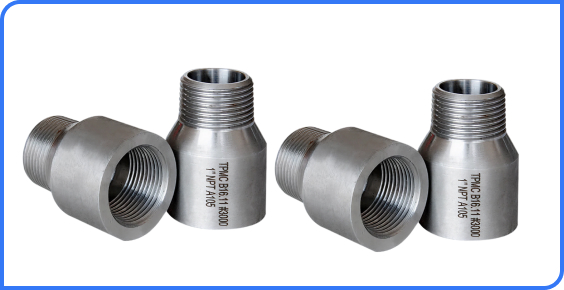
A Threaded Reducer is a pipe fitting that joins two pipes of different diameters, enabling a smooth transition in a threaded piping system. These reducers feature internal threads on both ends and are used in space-restricted or maintenance-heavy systems where welding is not feasible.
They are widely used in plumbing, HVAC, oil & gas, petrochemical, and compressed air systems, and are available in concentric and eccentric designs based on flow alignment requirements.
Key Features

Leak-Proof
Jointing

Durable
Construction

Easy Installation
& Removal

Wide
Compatibility

Corrosion
Resistant
Specifications
| Specification Category | Parameter / Feature | Details / Options |
|---|---|---|
| Size Range | Nominal Size | ½” to 4″ (custom sizes available) |
| Pressure Ratings | ANSI / ASME Class | Class 150, 300, 600, 900, 1500, 2500 |
| PN Ratings | PN6, PN10, PN16, PN25, PN40, PN64 | |
| Product Types | Threaded Reducer | Concentric, Eccentric |
| Material Options | Carbon Steel | ASTM A105, ASTM A350 LF2 |
| Stainless Steel | ASTM A182 F304, F316, F321 | |
| Alloy Steel | ASTM A182 F5, F9, F11, F22 | |
| Other Alloys | Monel, Inconel, Titanium | |
| Standards & Certifications | ASTM | ASTM A105, ASTM A182 |
| ASME / ANSI | ASME B16.11, ANSI B16.11 | |
| MSS | MSS SP-79, MSS SP-83 | |
| European Standards | EN 10222, EN 10204 | |
| Certifications | ISO 9001, PED 2014/68/EU, NACE MR0175, CE Marked | |
| Design Features | Wall Thickness | Schedule 40, Schedule 80, Schedule 160 |
| End Connections | Threaded (NPT, BSP, BSPT, PT) | |
| Pressure Class | 2000#, 3000#, 6000#, 9000# | |
| Tolerance | Thread Tolerance | As per ASME B1.1, ISO 7-1 |
| Coating & Surface Finish | Anti-Corrosion Coating | Zinc Plated, Hot Dip Galvanized, Stainless Steel Finish |
| Surface Finish | Mill Finish, Pickled, Polished, Bead Blasted | |
| Testing & Inspection | Pressure Testing | Hydrostatic, Pneumatic |
| Non-Destructive Testing | Radiography (RT), Ultrasonic (UT), Magnetic Particle (MPI), Dye Penetrant (DPT) | |
| Destructive Testing | Tensile, Hardness, Impact, Elongation |
Dimensions
| Fitting Type | Nominal Size (NPS) | Outside Diameter (OD) | Wall Thickness (Schedule) | Length (L) | End Connections | Weight per Piece |
|---|---|---|---|---|---|---|
| Threaded Reducer (Concentric) | ½” x ¾” | 21.3 mm | Schedule 40, Schedule 80 | 60 mm | Threaded (NPT, BSP, BSPT, PT) | 250g |
| Threaded Reducer (Concentric) | ¾” x 1″ | 26.7 mm | Schedule 40, Schedule 80 | 70 mm | Threaded (NPT, BSP, BSPT, PT) | 300g |
| Threaded Reducer (Concentric) | 1″ x 1½” | 33.4 mm | Schedule 40, Schedule 80 | 80 mm | Threaded (NPT, BSP, BSPT, PT) | 400g |
| Threaded Reducer (Concentric) | 1½” x 2″ | 48.3 mm | Schedule 40, Schedule 80 | 90 mm | Threaded (NPT, BSP, BSPT, PT) | 600g |
| Threaded Reducer (Concentric) | 2″ x 2½” | 60.3 mm | Schedule 40, Schedule 80 | 110 mm | Threaded (NPT, BSP, BSPT, PT) | 800g |
| Threaded Reducer (Concentric) | 2½” x 3″ | 73.0 mm | Schedule 40, Schedule 80 | 120 mm | Threaded (NPT, BSP, BSPT, PT) | 1.2kg |
| Threaded Reducer (Concentric) | 3″ x 4″ | 88.9 mm | Schedule 40, Schedule 80 | 140 mm | Threaded (NPT, BSP, BSPT, PT) | 1.5kg |
Mechanical Properties
| Property | Value | Unit / Standard |
|---|---|---|
| Tensile Strength | 485 – 750 | MPa (Carbon Steel, Stainless Steel, Alloy Steel) |
| Yield Strength | 170 – 450 | MPa |
| Hardness | 120 – 200 | HB (Brinell) |
| Elongation | ≥ 20 – 30 | % |
| Density | 7.8 – 8.0 | g/cm³ (Carbon Steel), 7.9 – 8.0 g/cm³ (Stainless Steel) |
| Impact Toughness | ≥ 27 – 70 | J (Charpy, grade-dependent) |
| Modulus of Elasticity (E) | ~200 | GPa |
| Fatigue Strength | 250 – 450 | MPa |
| Corrosion Resistance | Good to Excellent (SS > CS > Alloy Steel) | – |
| Thermal Conductivity | 15 – 50 | W/m·K |
| Coefficient of Thermal Expansion | 11 – 17 ×10⁻⁶ | /°C |
| Yield Ratio (YS/UTS) | 0.40 – 0.65 | – |
| Poisson’s Ratio | 0.27 – 0.30 | – |
| Brinell Hardness Range | 120 – 200 | HB |
| Surface Finish | Serrated / Stock / Smooth finish per ASME B16.11 | – |
| Threading Type | Threaded Connection (NPT, BSP, BSPT, PT) | – |
| Operating Temperature Range | -46 to 600 | °C (material-dependent) |
| Pressure Rating | Class 150, 300, 600, 900, 1500, 2500 | ASME B16.11 |
Chemical Composition
| Element | Composition (%) |
|---|---|
| Carbon (C) | 0.08 – 0.35 |
| Manganese (Mn) | 0.60 – 1.65 |
| Silicon (Si) | 0.15 – 0.80 |
| Chromium (Cr) | 18.0 – 20.0 (Stainless Steel) |
| Nickel (Ni) | 8.0 – 10.5 (SS 304/316) |
| Molybdenum (Mo) | 2.0 – 3.0 (for F316 only) |
| Phosphorus (P) | ≤ 0.035 |
| Sulfur (S) | ≤ 0.040 |
| Iron (Fe) | Balance |
Applications of Threaded Reducer
Construction &
Infrastructure
Automotive & Heavy
Equipment
Manufacturing &
Fabrication
Medical & Laboratory
Equipment
Electrical &
Electronics Assembly
Oil, Gas & Petrochemical
Installations
Do you have questions?
A reducer has a uniform cylindrical profile; a bushing has a stepped shape and is often hex-head.
Yes, we provide custom dual-thread reducers (e.g., BSP x NPT) on request.
Yes, we offer Class 3000 and 6000-rated reducers for high-pressure operations.
Absolutely. Zinc-plated, PTFE-coated, and epoxy-coated reducers are available.