
Socket Weld Reducer
What are Socket Weld Reducers?
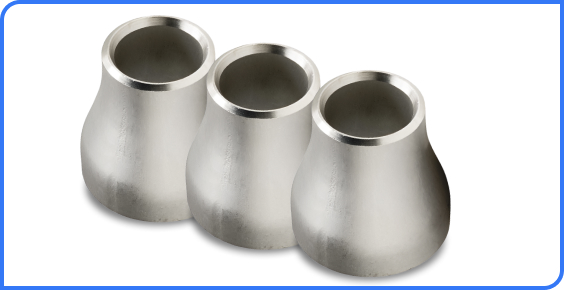
A Socket Weld Reducer is a forged pipe fitting used to connect two pipes of different diameters in high-pressure systems, ensuring a secure, leak-proof transition. It features socket ends on both sides where the pipes are inserted and welded externally. This design provides excellent structural integrity, making it ideal for applications involving pressure, vibration, or thermal expansion.
Socket weld reducers are commonly found in oil & gas refineries, steam lines, power generation systems, and chemical plants, and are available in concentric and eccentric designs based on flow alignment requirements.
Key Features

Leak-Proof
Jointing

Durable
Construction

Easy Installation
& Removal

Wide
Compatibility

Corrosion
Resistant
Specifications
| Specification Category | Parameter / Feature | Details / Options |
|---|---|---|
| Size Range | Nominal Size | ½” to 4″ (custom sizes available) |
| Pressure Ratings | ANSI / ASME Class | Class 150, 300, 600, 900, 1500, 2500 |
| PN Ratings | PN6, PN10, PN16, PN25, PN40, PN64 | |
| Product Types | Socket Weld Reducers | Concentric, Eccentric |
| Material Options | Carbon Steel | ASTM A105, ASTM A350 LF2 |
| Stainless Steel | ASTM A182 F304, F316, F321 | |
| Alloy Steel | ASTM A182 F5, F9, F11, F22 | |
| Other Alloys | Monel, Inconel, Titanium | |
| Standards & Certifications | ASTM | ASTM A105, ASTM A182 |
| ASME / ANSI | ASME B16.11, ANSI B16.11 | |
| MSS | MSS SP-79, MSS SP-83 | |
| European Standards | EN 10222, EN 10204 | |
| Certifications | ISO 9001, PED 2014/68/EU, NACE MR0175, CE Marked | |
| Design Features | Wall Thickness | Schedule 40, Schedule 80, Schedule 160 |
| End Connections | Socket Weld Connection | |
| Pressure Class | 2000#, 3000#, 6000#, 9000# | |
| Tolerance | Thread Tolerance | As per ASME B1.1, ISO 7-1 |
| Coating & Surface Finish | Anti-Corrosion Coating | Zinc Plated, Hot Dip Galvanized, Stainless Steel Finish |
| Surface Finish | Mill Finish, Pickled, Polished, Bead Blasted | |
| Testing & Inspection | Pressure Testing | Hydrostatic, Pneumatic |
| Non-Destructive Testing | Radiography (RT), Ultrasonic (UT), Magnetic Particle (MPI), Dye Penetrant (DPT) | |
| Destructive Testing | Tensile, Hardness, Impact, Elongation |
Dimensions
| Nominal Size (NPS) | Outside Diameter (OD) | Wall Thickness (Schedule) | Length (L) | Weight per Piece |
|---|---|---|---|---|
| ½” | 21.3 mm | Schedule 40, Schedule 80 | 50 mm | 200g |
| ¾” | 26.7 mm | Schedule 40, Schedule 80 | 55 mm | 300g |
| 1″ | 33.4 mm | Schedule 40, Schedule 80 | 70 mm | 450g |
| 1½” | 48.3 mm | Schedule 40, Schedule 80 | 80 mm | 600g |
| 2″ | 60.3 mm | Schedule 40, Schedule 80 | 90 mm | 800g |
| 2½” | 73.0 mm | Schedule 40, Schedule 80 | 110 mm | 1.2kg |
| 3″ | 88.9 mm | Schedule 40, Schedule 80 | 120 mm | 1.5kg |
| 4″ | 114.3 mm | Schedule 40, Schedule 80 | 150 mm | 2.0kg |
Mechanical Properties
| Property | Value | Unit / Standard |
|---|---|---|
| Tensile Strength | 485 – 750 | MPa (Carbon Steel, Stainless Steel, Alloy Steel) |
| Yield Strength | 170 – 450 | MPa |
| Hardness | 120 – 200 | HB (Brinell) |
| Elongation | ≥ 20 – 30 | % |
| Density | 7.8 – 8.0 | g/cm³ (Carbon Steel), 7.9 – 8.0 g/cm³ (Stainless Steel) |
| Impact Toughness | ≥ 27 – 70 | J (Charpy, grade-dependent) |
| Modulus of Elasticity (E) | ~200 | GPa |
| Fatigue Strength | 250 – 450 | MPa |
| Corrosion Resistance | Good to Excellent (SS > CS > Alloy Steel) | – |
| Thermal Conductivity | 15 – 50 | W/m·K |
| Coefficient of Thermal Expansion | 11 – 17 ×10⁻⁶ | /°C |
| Yield Ratio (YS/UTS) | 0.40 – 0.65 | – |
| Poisson’s Ratio | 0.27 – 0.30 | – |
| Brinell Hardness Range | 120 – 200 | HB |
| Surface Finish | Mill Finish, Pickled, Polished, Bead Blasted | – |
| Welding Type | Socket Weld Connection | – |
| Operating Temperature Range | -46 to 600 | °C (material-dependent) |
| Pressure Rating | Class 150, 300, 600, 900, 1500, 2500 | ASME B16.11 |
Chemical Composition
| Element | Composition (%) |
|---|---|
| Carbon (C) | 0.08 – 0.35 |
| Manganese (Mn) | 0.60 – 1.65 |
| Silicon (Si) | 0.15 – 0.80 |
| Chromium (Cr) | 18.0 – 20.0 (SS only) |
| Nickel (Ni) | 8.0 – 10.5 (SS only) |
| Molybdenum (Mo) | 2.0 – 3.0 (For 316) |
| Phosphorus (P) | ≤ 0.035 |
| Sulfur (S) | ≤ 0.040 |
| Iron (Fe) | Balance |
Weight
| Reducer Type | Size (inches) | Weight per 100 pcs (kg) |
|---|---|---|
| Concentric Reducer | 1″ x ¾” | 10.80 |
| Concentric Reducer | 1½” x 1″ | 14.60 |
| Concentric Reducer | 2″ x 1″ | 18.50 |
Applications of Socket Weld Reducers
Construction &
Infrastructure
Automotive & Heavy
Equipment
Manufacturing &
Fabrication
Medical & Laboratory
Equipment
Electrical &
Electronics Assembly
Oil, Gas & Petrochemical
Installations
Do you have questions?
It allows connection between two pipes of different diameters while maintaining pressure and flow efficiency.
Yes, we offer both types, although concentric is standard in socket weld configurations.
Yes, especially concentric reducers for maintaining centerline flow. Use eccentric if drainage is required.
Yes. We provide Mill Test Certificates (MTCs) and optional TPI reports upon request.