
Buttweld Tee
What is a Buttweld Tee?
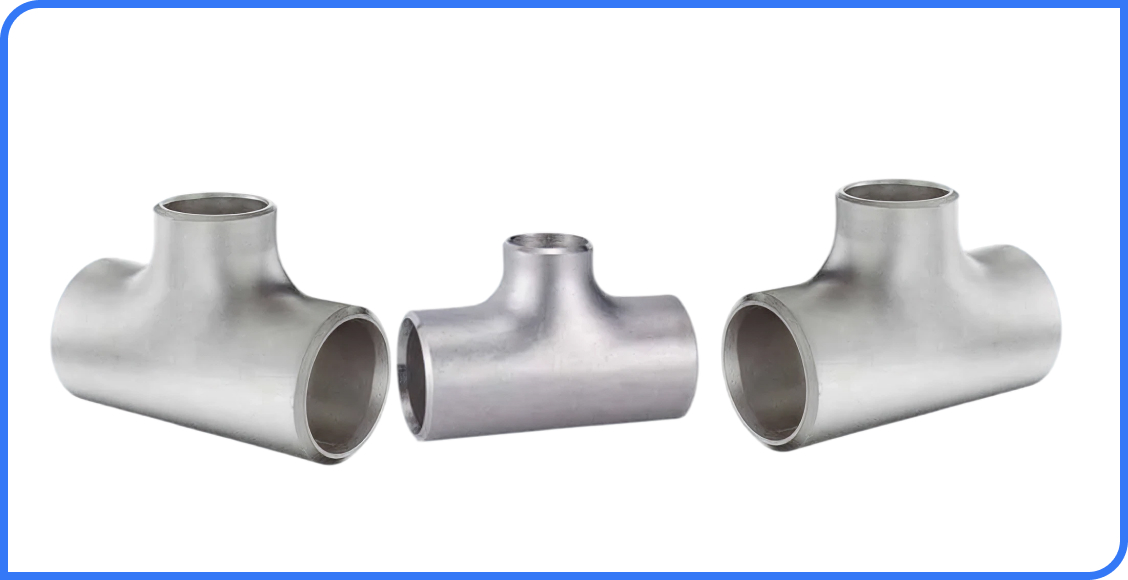
A Buttweld Tee is a T-shaped buttweld fitting used to combine or divide fluid flow in a pipeline. It features three connection points—two in-line and one branch—welded to the pipes to ensure a permanent, high-strength, leak-free joint.
Buttweld tees are available in equal and reducing types, making them essential for fluid distribution or collection systems in industries such as petrochemical, power generation, shipbuilding, and chemical processing.
Key Features
Leak-Proof
Jointing

Durable
Construction

High Pressure
Resistance

Wide
Compatibility

Corrosion
Resistant
Specifications
| Specification Category | Parameter / Feature | Details / Options |
|---|---|---|
| Size Range | Nominal Size | ½” to 48″ (custom sizes available) |
| Pressure Ratings | ANSI / ASME Class | Class 150, 300, 600, 900, 1500, 2500 |
| PN Ratings | PN6, PN10, PN16, PN25, PN40, PN64 | |
| Product Types | Butt Weld Tee | Equal, Reducing |
| Material Options | Carbon Steel | ASTM A234 WPB, ASTM A420 WPL6 |
| Stainless Steel | ASTM A403 WP304, WP316, WP321, WP347 | |
| Alloy Steel | ASTM A234 WP5, WP9, WP11, WP22 | |
| Other Alloys | Monel, Inconel, Titanium | |
| Standards & Certifications | ASTM | ASTM A234, ASTM A403 |
| ASME / ANSI | ASME B16.9, ANSI B16.9 | |
| MSS | MSS SP-75, MSS SP-43 | |
| European Standards | EN 10253-1, EN 10222 | |
| Certifications | ISO 9001, PED 2014/68/EU, NACE MR0175, CE Marked | |
| Design Features | Wall Thickness | Schedule 40, Schedule 80, Schedule 160 |
| End Connections | Butt Weld Ends | |
| Pressure Class | 2000#, 3000#, 6000#, 9000# | |
| Tolerance | Dimensional Tolerance | As per ASME B16.9 / B16.28 |
| Coating & Surface Finish | Anti-Corrosion Coating | Passivation, Epoxy Coating, Zinc Plated |
| Surface Finish | Mill Finish, Polished, Pickled, Bead Blasted | |
| Testing & Inspection | Pressure Testing | Hydrostatic, Pneumatic |
| Non-Destructive Testing | Radiography (RT), Ultrasonic (UT), Dye Penetrant (DPT), Magnetic Particle (MPI) | |
| Destructive Testing | Tensile, Hardness, Impact, Flattening |
Dimensions
| Fitting Type | Nominal Size (NPS) | Outside Diameter (OD) | Wall Thickness (Schedule) | Length (L) | Weight per Piece |
|---|---|---|---|---|---|
| Butt Weld Tee (Equal) | ½” | 21.3 mm | Schedule 40, 80 | 55 mm | 250g |
| Butt Weld Tee (Equal) | ¾” | 26.7 mm | Schedule 40, 80 | 65 mm | 350g |
| Butt Weld Tee (Equal) | 1″ | 33.4 mm | Schedule 40, 80 | 75 mm | 450g |
| Butt Weld Tee (Equal) | 1½” | 48.3 mm | Schedule 40, 80 | 90 mm | 700g |
| Butt Weld Tee (Equal) | 2″ | 60.3 mm | Schedule 40, 80 | 100 mm | 1.0kg |
| Butt Weld Tee (Equal) | 2½” | 73.0 mm | Schedule 40, 80 | 120 mm | 1.5kg |
| Butt Weld Tee (Equal) | 3″ | 88.9 mm | Schedule 40, 80 | 140 mm | 2.0kg |
| Butt Weld Tee (Equal) | 4″ | 114.3 mm | Schedule 40, 80 | 160 mm | 2.5kg |
Mechanical Properties
| Property | Value | Unit / Standard |
|---|---|---|
| Tensile Strength | 485 – 750 | MPa (Carbon Steel, Stainless Steel, Alloy Steel) |
| Yield Strength | 170 – 450 | MPa |
| Hardness | 120 – 200 | HB (Brinell) |
| Elongation | ≥ 20 – 30 | % |
| Density | 7.8 – 8.0 | g/cm³ (Carbon Steel), 7.9 – 8.0 g/cm³ (Stainless Steel) |
| Impact Toughness | ≥ 27 – 70 | J (Charpy, grade-dependent) |
| Modulus of Elasticity (E) | ~200 | GPa |
| Fatigue Strength | 250 – 450 | MPa |
| Corrosion Resistance | Good to Excellent (SS > CS > Alloy Steel) | – |
| Thermal Conductivity | 15 – 50 | W/m·K |
| Coefficient of Thermal Expansion | 11 – 17 ×10⁻⁶ | /°C |
| Yield Ratio (YS/UTS) | 0.40 – 0.65 | – |
| Poisson’s Ratio | 0.27 – 0.30 | – |
| Brinell Hardness Range | 120 – 200 | HB |
| Surface Finish | Mill Finish, Pickled, Polished, Bead Blasted | – |
| Welding Type | Butt Weld Ends | – |
| Operating Temperature Range | -46 to 600 | °C (material-dependent) |
| Pressure Rating | Class 150, 300, 600, 900, 1500, 2500 | ASME B16.9 / B16.28 |
Chemical Composition
| Element | SS 304 | SS 304L | SS 316 | SS 316L |
|---|---|---|---|---|
| Chromium (Cr) | 18.0 – 20.0 | 18.0 – 20.0 | 16.0 – 18.0 | 16.0 – 18.0 |
| Nickel (Ni) | 8.0 – 10.5 | 8.0 – 12.0 | 10.0 – 14.0 | 10.0 – 14.0 |
| Carbon (C) | ≤ 0.08 | ≤ 0.03 | ≤ 0.08 | ≤ 0.03 |
| Manganese (Mn) | ≤ 2.00 | ≤ 2.00 | ≤ 2.00 | ≤ 2.00 |
| Silicon (Si) | ≤ 1.00 | ≤ 1.00 | ≤ 1.00 | ≤ 1.00 |
| Phosphorus (P) | ≤ 0.045 | ≤ 0.045 | ≤ 0.045 | ≤ 0.045 |
| Sulfur (S) | ≤ 0.030 | ≤ 0.030 | ≤ 0.030 | ≤ 0.030 |
| Iron (Fe) | Balance | Balance | Balance | Balance |
| Molybdenum (Mo) | — | — | 2.0 – 3.0 | 2.0 – 3.0 |
Applications of Buttweld Tees
Construction &
Infrastructure
Automotive & Heavy
Equipment
Manufacturing &
Fabrication
Medical & Laboratory
Equipment
Electrical &
Electronics Assembly
Oil, Gas & Petrochemical
Installations
Do you have questions?
A reducing tee allows branching to a smaller diameter pipe, making it ideal for step-down flow systems.
Yes. They’re suitable for both horizontal and vertical pipeline branches.
Both are available. We supply seamless tees for high-pressure use and welded tees for standard applications.
Yes. On request, we supply tees with PED, NACE MR0175, and 3.1/3.2 certifications.