
Socket Weld Crosses
What are Socket Weld Crosses?
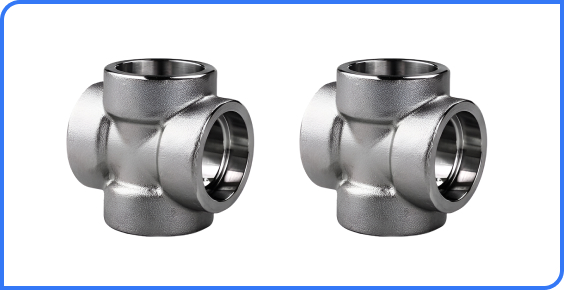
A Socket Weld Cross is a forged pipe fitting used to create a four-way connection where one inlet divides into three outlets or vice versa. These fittings are engineered for high-pressure, small-bore systems, providing precise, leak-proof multi-directional flow in process pipelines.
Asiad Steel Industries is a leading manufacturer, supplier, and exporter of premium-quality Socket Weld Crosses in various sizes, grades, and finishes, providing robust and versatile piping solutions for a wide range of industrial applications globally.
Key Features

Leak-Proof
Jointing

Durable
Construction

Easy Installation
& Removal

Wide
Compatibility

Corrosion
Resistant
Specifications
| Specification Category | Parameter / Feature | Details / Options |
|---|---|---|
| Size Range | Nominal Size | ½” to 4″ (custom sizes available) |
| Pressure Ratings | ANSI / ASME Class | Class 150, 300, 600, 900, 1500, 2500 |
| PN Ratings | PN6, PN10, PN16, PN25, PN40, PN64 | |
| Product Types | Socket Weld Cross | Equal, Reducing |
| Material Options | Carbon Steel | ASTM A105, ASTM A350 LF2 |
| Stainless Steel | ASTM A182 F304, F316, F321 | |
| Alloy Steel | ASTM A182 F5, F9, F11, F22 | |
| Other Alloys | Monel, Inconel, Titanium | |
| Standards & Certifications | ASTM | ASTM A105, ASTM A182 |
| ASME / ANSI | ASME B16.11, ANSI B16.11 | |
| MSS | MSS SP-79, MSS SP-83 | |
| European Standards | EN 10222, EN 10204 | |
| Certifications | ISO 9001, PED 2014/68/EU, NACE MR0175, CE Marked | |
| Design Features | Wall Thickness | Schedule 40, Schedule 80, Schedule 160 |
| End Connections | Socket Weld Connection | |
| Pressure Class | 2000#, 3000#, 6000#, 9000# | |
| Tolerance | Thread Tolerance | As per ASME B1.1, ISO 7-1 |
| Coating & Surface Finish | Anti-Corrosion Coating | Zinc Plated, Hot Dip Galvanized, Stainless Steel Finish |
| Surface Finish | Mill Finish, Pickled, Polished, Bead Blasted | |
| Testing & Inspection | Pressure Testing | Hydrostatic, Pneumatic |
| Non-Destructive Testing | Radiography (RT), Ultrasonic (UT), Magnetic Particle (MPI), Dye Penetrant (DPT) | |
| Destructive Testing | Tensile, Hardness, Impact, Elongation |
Dimensions
| Nominal Size (NPS) | Outside Diameter (OD) | Wall Thickness (Schedule) | Length (L) | End Connections | Weight per Piece |
|---|---|---|---|---|---|
| ½” | 21.3 mm | Schedule 40, Schedule 80 | 60 mm | Socket Weld | 250g |
| ¾” | 26.7 mm | Schedule 40, Schedule 80 | 70 mm | Socket Weld | 350g |
| 1″ | 33.4 mm | Schedule 40, Schedule 80 | 80 mm | Socket Weld | 500g |
| 1½” | 48.3 mm | Schedule 40, Schedule 80 | 90 mm | Socket Weld | 700g |
| 2″ | 60.3 mm | Schedule 40, Schedule 80 | 100 mm | Socket Weld | 1.0kg |
| 2½” | 73.0 mm | Schedule 40, Schedule 80 | 120 mm | Socket Weld | 1.5kg |
| 3″ | 88.9 mm | Schedule 40, Schedule 80 | 140 mm | Socket Weld | 2.0kg |
| 4″ | 114.3 mm | Schedule 40, Schedule 80 | 160 mm | Socket Weld | 2.5kg |
Mechanical Properties
| Property | Value | Unit / Standard |
|---|---|---|
| Tensile Strength | 485 – 750 | MPa (Carbon Steel, Stainless Steel, Alloy Steel) |
| Yield Strength | 170 – 450 | MPa |
| Hardness | 120 – 200 | HB (Brinell) |
| Elongation | ≥ 20 – 30 | % |
| Density | 7.8 – 8.0 | g/cm³ (Carbon Steel), 7.9 – 8.0 g/cm³ (Stainless Steel) |
| Impact Toughness | ≥ 27 – 70 | J (Charpy, grade-dependent) |
| Modulus of Elasticity (E) | ~200 | GPa |
| Fatigue Strength | 250 – 450 | MPa |
| Corrosion Resistance | Good to Excellent (SS > CS > Alloy Steel) | – |
| Thermal Conductivity | 15 – 50 | W/m·K |
| Coefficient of Thermal Expansion | 11 – 17 ×10⁻⁶ | /°C |
| Yield Ratio (YS/UTS) | 0.40 – 0.65 | – |
| Poisson’s Ratio | 0.27 – 0.30 | – |
| Brinell Hardness Range | 120 – 200 | HB |
| Surface Finish | Mill Finish, Pickled, Polished, Bead Blasted | – |
| Welding Type | Socket Weld Connection | – |
| Operating Temperature Range | -46 to 600 | °C (material-dependent) |
| Pressure Rating | Class 150, 300, 600, 900, 1500, 2500 | ASME B16.11 |
Chemical Composition
| Element | SS 304 | SS 304L | SS 316 | SS 316L |
|---|---|---|---|---|
| Chromium (Cr) | 18.0 – 20.0 | 18.0 – 20.0 | 16.0 – 18.0 | 16.0 – 18.0 |
| Nickel (Ni) | 8.0 – 10.5 | 8.0 – 12.0 | 10.0 – 14.0 | 10.0 – 14.0 |
| Carbon (C) | ≤ 0.08 | ≤ 0.03 | ≤ 0.08 | ≤ 0.03 |
| Manganese (Mn) | ≤ 2.00 | ≤ 2.00 | ≤ 2.00 | ≤ 2.00 |
| Silicon (Si) | ≤ 1.00 | ≤ 1.00 | ≤ 1.00 | ≤ 1.00 |
| Phosphorus (P) | ≤ 0.045 | ≤ 0.045 | ≤ 0.045 | ≤ 0.045 |
| Sulfur (S) | ≤ 0.030 | ≤ 0.030 | ≤ 0.030 | ≤ 0.030 |
| Iron (Fe) | Balance | Balance | Balance | Balance |
| Molybdenum (Mo) | — | — | 2.0 – 3.0 | 2.0 – 3.0 |
Applications of Socket Weld Crosses
Dairy & Milk Processing
Units
Beverage Plants
Pharmaceutical
Food Processing &
Edible Oil Units
Chemical & Enzyme
Production
Dairy R&D and Quality
Testing Labs
Do you have questions?
It enables four-way branching—helpful in multi-line systems, metering loops, or where multiple flow routes are required.
Yes, more than elbows or tees, especially if not properly sized or balanced. Use with flow calculation.
Yes, including Inconel, Hastelloy, and Duplex Steel, depending on pressure and fluid requirements.
Yes. With proper support, socket weld crosses are equally effective in both orientations.