
Gate Valve
What are Gate Valves?
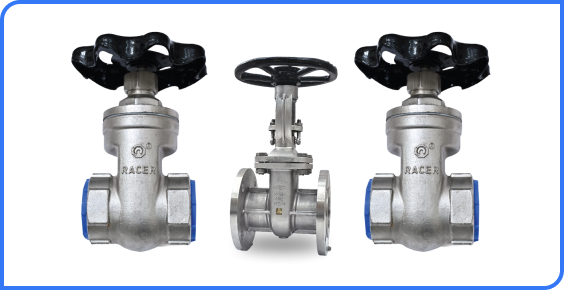
Gate Valves are linear motion valves used to start or stop the flow of liquids in a pipeline. These valves operate by lifting a gate out of the flow path, allowing full unobstructed passage. Ideal for applications requiring minimal pressure drop and bi-directional flow, gate valves are widely used in water supply systems, oil and gas processing, and industrial piping networks.
Asiad Steel Industries is a leading manufacturer and exporter of high-quality Gate Valves under the Racer brand for standard and customized applications across various sectors.
Key Features

Leak-Proof
Jointing

Robust
Construction

High Pressure
Resistance

Standards
Compliant

Corrosion
Resistant
Specifications
| Specification Category | Parameter / Feature | Details / Options |
|---|---|---|
| Size Range | Nominal Pipe Size (NPS) | ½” to 48” (DN15 – DN1200) |
| Pressure Ratings | ANSI / ASME Class | Class 150, 300, 600, 900, 1500, 2500 |
| PN Ratings | PN Ratings | PN6, PN10, PN16, PN25, PN40, PN64 |
| Fitting Types | Gate Valve | Gate Valve FE |
| Material Options | Stainless Steel | SS 304, SS 304L, SS 316, SS 316L, SS 321 |
| Standards & Certifications | ASME / ANSI | ASME B16.34 (Gate Valves), ASME B16.10 (Face-to-Face), ASME B16.5 (Flanged Ends) |
| ASTM | ASTM A351, ASTM A182, ASTM A479 | |
| European Standards | EN 558, EN 1092, DIN 3352 | |
| Certifications | ISO 9001, PED 2014/68/EU, NACE MR0175, IBR Approved | |
| Design Features | Wall Thickness | As per ASME B36.10 (CS), ASME B36.19 (SS), customized options |
| End Connections | Flanged Ends, Threaded Ends, Butt Weld Ends | |
| Tolerance | As per ASME / ANSI standards | |
| Coating & Surface Finish | Anti-Corrosion Coating | Rust Preventive Oil, Black Oxide, Hot-Dip Galvanized |
| Optional Coatings | Epoxy, PTFE, Polyurethane | |
| Surface Finish | Machined, Pickled, Polished, Passivated | |
| Testing & Inspection | Pressure Testing | Hydrostatic, Pneumatic |
| Non-Destructive Testing | Radiography (RT), Ultrasonic (UT), Magnetic Particle (MPI), Dye Penetrant (DPT) | |
| Destructive Testing | Tensile, Hardness, Impact |
Dimensions
| Nominal Size (NPS) | Face-to-Face (L) | Flange Diameter (D) | Bolt Circle Diameter (K) | No. of Bolts (n) | Bolt Size (d) | Flange Thickness (t) | Height Open (H1) | Height Closed (H2) |
|---|---|---|---|---|---|---|---|---|
| ½” (DN15) | 102 | 114 | 89 | 4 | 14 | 16 | 180 | 120 |
| ¾” (DN20) | 114 | 127 | 102 | 4 | 14 | 18 | 200 | 140 |
| 1” (DN25) | 127 | 140 | 114 | 4 | 14 | 18 | 230 | 160 |
| 1½” (DN40) | 178 | 165 | 135 | 4 | 18 | 20 | 280 | 190 |
| 2” (DN50) | 203 | 190 | 156 | 4 | 18 | 20 | 310 | 210 |
| 2½” (DN65) | 241 | 216 | 184 | 8 | 18 | 22 | 380 | 260 |
| 3” (DN80) | 267 | 229 | 190 | 8 | 18 | 22 | 420 | 280 |
| 4” (DN100) | 292 | 254 | 216 | 8 | 22 | 24 | 500 | 340 |
| 6” (DN150) | 356 | 305 | 272 | 8 | 22 | 26 | 650 | 430 |
| 8” (DN200) | 406 | 381 | 337 | 8 | 26 | 28 | 780 | 520 |
| 10” (DN250) | 483 | 445 | 406 | 12 | 26 | 30 | 950 | 650 |
| 12” (DN300) | 533 | 505 | 468 | 12 | 30 | 32 | 1150 | 780 |
Mechanical Properties
| Property | Value | Unit / Standard |
|---|---|---|
| Tensile Strength | 485 – 750 | MPa (Stainless Steel, Carbon Steel, Alloy Steel) |
| Yield Strength | 170 – 450 | MPa |
| Hardness | 120 – 200 | HB (Brinell) |
| Elongation | ≥ 20 – 30 | % |
| Density | 7.8 – 8.0 | g/cm³ |
| Impact Toughness | ≥ 27 – 70 | J (Charpy, grade-dependent) |
| Modulus of Elasticity (E) | ~200 | GPa |
| Fatigue Strength | 250 – 450 | MPa |
| Corrosion Resistance | Good to Excellent (SS > CS > Alloy Steel) | – |
| Thermal Conductivity | 15 – 50 | W/m·K |
| Coefficient of Thermal Expansion | 11 – 17 ×10⁻⁶ | /°C |
| Yield Ratio (YS/UTS) | 0.40 – 0.65 | – |
| Poisson’s Ratio | 0.27 – 0.30 | – |
| Brinell Hardness Range | 120 – 200 | HB |
| Surface Finish | Machined / Polished / Passivated | – |
| Operating Temperature Range | -46 to 600 | °C (material-dependent) |
| Pressure Rating | Class 150, 300, 600, 900, 1500, 2500 | ASME B16.34 Standards |
| End Connection Type | Flanged / Threaded / Butt-Weld | – |
Chemical Composition
| Element | SS 304 (%) | SS 304L (%) | SS 316 (%) | SS 316L (%) |
|---|---|---|---|---|
| Carbon (C) | ≤ 0.08 | ≤ 0.03 | ≤ 0.08 | ≤ 0.03 |
| Manganese (Mn) | ≤ 2.00 | ≤ 2.00 | ≤ 2.00 | ≤ 2.00 |
| Silicon (Si) | ≤ 1.00 | ≤ 1.00 | ≤ 1.00 | ≤ 1.00 |
| Phosphorus (P) | ≤ 0.045 | ≤ 0.045 | ≤ 0.045 | ≤ 0.045 |
| Sulfur (S) | ≤ 0.030 | ≤ 0.030 | ≤ 0.030 | ≤ 0.030 |
| Chromium (Cr) | 18.0 – 20.0 | 18.0 – 20.0 | 16.0 – 18.0 | 16.0 – 18.0 |
| Nickel (Ni) | 8.0 – 10.5 | 8.0 – 12.0 | 10.0 – 14.0 | 10.0 – 14.0 |
| Molybdenum (Mo) | — | — | 2.0 – 3.0 | 2.0 – 3.0 |
| Nitrogen (N) | — | — | ≤ 0.10 | ≤ 0.10 |
| Iron (Fe) | Balance | Balance | Balance | Balance |
Applications of Gate Valves
Dairy & Milk Processing
Units
Beverage Plants
Pharmaceutical
Food Processing &
Edible Oil Units
Chemical & Enzyme
Production
Dairy R&D and Quality
Testing Labs
Do you have questions?
Use gate valves for simple on/off isolation where minimum pressure drop is critical; use globe valves for precise throttling and flow regulation.
Not ideal. Gate valves are not recommended for throttling as partial opening may damage the sealing surfaces.
Rising stem valves indicate valve position externally, while non-rising stem valves are better for space-constrained setups.
Not typically. Viscous or slurry media may lead to accumulation and damage. Specialized valves are recommended.